Callie Norton
April 7, 2026
•
6
min read

As your practice grows, patient follow-up automation can help your team respond faster, stay organized, and keep potential patients from slipping through the cracks. For healthcare practices, delayed follow-up can mean missed appointment opportunities, more front-desk strain, and a less consistent patient experience.
But can automated outreach still feel personal, or does it always come across as robotic?
In this post, we’ll show you how to build a patient follow-up process that is fast, consistent, and still feels true to your practice.
How Patient Follow-Up Automation Helps You Respond Faster
More patients means more calls, web forms, and messages across different channels, arriving at all hours of the day. A front desk built for one era of patient communication can't absorb that volume without something falling through. And today's patients make that gap impossible to ignore:
Patients aren't just reaching out more often. They're reaching out faster, across more channels, and with higher expectations than a manual process was ever built to meet.
If automation still gives you pause, think of it this way:
Patients aren't reaching out because they want the perfect message. It's because they need something, and they want to know you're there to help.
When it comes to speed to lead in healthcare practices, a prompt, simple response does more for that feeling than a beautifully written callback that arrives two days late (or not at all).
The most caring thing a practice can do is show up quickly, acknowledge the inquiry, and let the patient know what comes next. That's not robotic. That's responsive.
When most private practices think about human follow-up, they picture a staff member picking up the phone or personally typing out a response. That image can be hard to let go of, often because it feels like the gold standard of care. But if a patient fills out a form on a Tuesday night and doesn't hear back until Thursday afternoon, that interaction was technically human and it still failed them.
Human follow-up isn't defined by who sends the message. Instead, it’s whether the patient felt acknowledged, informed, and taken care of. Timely, relevant, and clear communication does that just as well as a handwritten note (sometimes better!).
After all, the goal has always been the patient's experience—not the effort behind it.
Automation earns its place in the parts of the process that are time-sensitive and easy to get wrong when left to chance. Think immediate acknowledgments, appointment reminders, and re-engagement for patients who showed interest but never booked. When your team isn't buried in that kind of repetitive follow-up, they have more bandwidth for the conversations that deserve their full attention.
Something to keep in mind: automation works best when it knows its lane.
Nuanced questions, scheduling exceptions, and emotionally sensitive conversations need a real person. So do higher-intent leads who are close to booking and just need a little reassurance to get there.
When automation has already handled the repetitive touchpoints, your team can give those moments the attention they deserve.
Doctible’s Patient Link helps medical, dental, and other healthcare practices manage patient follow-up automation more efficiently by capturing inquiries, automating outreach, and giving teams visibility into every step of the lead journey.
From the first point of contact to a booked appointment, Patient Link supports a seamless digital patient journey that's captured, automated, and visible in one place.
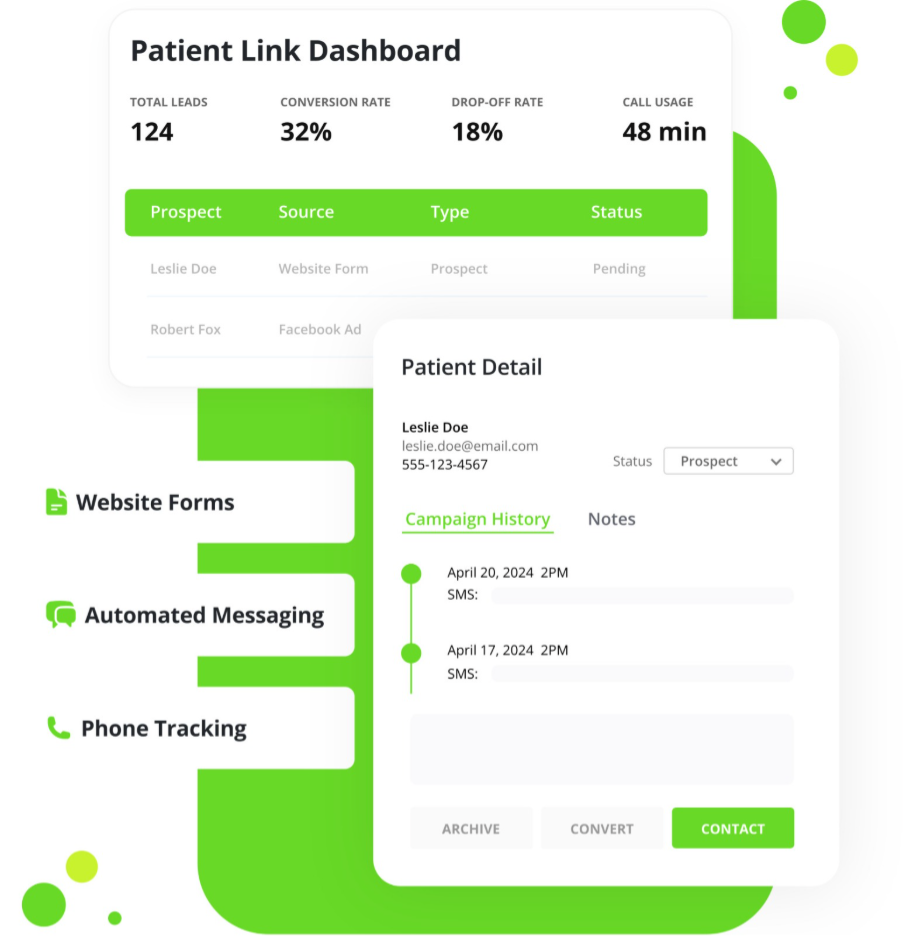
Patient Link automatically logs every call and web form the moment it arrives. That means your team doesn’t have to hunt through disconnected channels or rely on whoever happened to answer the phone. When a new inquiry comes in, it's already tracked and ready for follow-up.
Patient Link automates texts and emails so your team doesn't have to manually chase down every new lead. When a patient reaches out, a response is sent automatically without anyone having to remember to follow up. That means your practice can respond to new booking requests automatically, even outside business hours, without adding more manual work for your team.
A centralized dashboard gives your team a real-time view of where every prospect stands. With a full activity timeline and flexible review tools, staff can see what's been sent, what's been opened, and exactly when to step in with a personal touch.
Generic outreach is what makes automation feel robotic. Patient Link allows practices to deliver personalized patient messaging based on appointment need, lead source, or how a prospect has engaged so far. The right message goes to the right patient at the right time, helping your communication feel anything but automated.
Most practices don't realize how much their follow-up process is costing them until they start looking for the signs. If any of these feel familiar, it may be time to rethink the system behind your outreach:
Any one of these is a missed opportunity. Together, they add up to a pattern of patient loss that's easy to overlook and hard to recover from without the right infrastructure in place.
Not every patient communication software that claims to handle follow-up actually closes the loop. When evaluating your options, here's what a complete solution should cover:
If a platform can't do all of these things in one place, you're still piecing together the process manually somewhere.
Building a follow-up process that's efficient and still feels personal isn't as complicated as it sounds. With Doctible's Patient Link, your practice can capture every inquiry, automate outreach, and show up for patients the way only your practice can.
Book a demo to see how Doctible helps practices automate patient follow-up while keeping communication personal.

Alturbag, M. (2024). Factors and Reasons Associated with Appointment Non-attendance in Hospitals: A Narrative Review. Cureus, 16(4). https://doi.org/10.7759/cureus.58594
Chen, A. M. (2024, September 11). Same-day Service: Why Healthcare Cannot Continue to Be the Exception. BMJ Journals. https://bmjleader.bmj.com/content/9/2/182
Kristiansen, E., Atherton, H., Austad, B., Trine Strand Bergmo, Norberg, B. L., Salisbury, C., & Paolo Zanaboni. (2025). Patients’ Use of e-Consultations as an Alternative to Other General Practitioner Services: Cross-Sectional Survey Study. Journal of Medical Internet Research, 27, e55158–e55158. https://doi.org/10.2196/55158

If you want the best digital patient engagement and marketing platform, you need Doctible.